
The idea of creating the "Index of the Repressed", a comprehensive computerized collection of information about people repressed in the USSR, appeared in early 1988, a few weeks after the Eastern Archives now one of the KARTA Center's agencies, began work. The main goal was to collect and preserve various types of testimonies of people who were under Soviet occupation or in prisons, labour camps or exiles, i.e. accounts, diaries, letters, photographs and souvenirs. Initially, the data was collected mainly in the form of personal questionnaires, filled in by victims of Soviet repression or their families, as well as on the basis of information contained in accounts and memories collected at the Eastern Archives. With time, a decision was made to create an electronic database.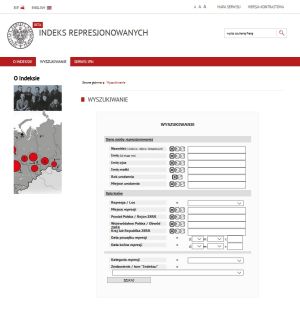
Computerized data from personal questionnaires, as well as from source materials from the post-Soviet archives, obtained from the beginning of the 1990s through the "Memorial" Association in Moscow, allowed the creation of the so-called internal database of the "Index of the Repressed" programme. In addition to the personal questionnaires mentioned above, it also computerizes name lists collected at the Eastern Archives, various types of lists and data sets on the victimized, such as data from the file of personal files of Polish prisoners of war in the USSR from the Collection of Files from Russian Archives stored in the Central Military Archive, data from the database computer office of War Veterans and Victims of Oppression, computer databases prepared by the "Memorial" Association in Moscow, data from certificates issued to individual applicants by the archives of the former USSR thanks to cooperation with the "Memorial" Association, censuses prepared in the USSR after 1943 by the Union of Polish Patriots, stored in the Archives of New Files, data from the "Main Book of the Orphanage" in Gostynin, which is a list of children and employees of Polish orphanages in the USSR, repatriated in 1946.
Over 25 years, about 1,200,000 records have been entered into the database. After systematizing the categories of Soviet repression, the goal of the programme was not just to collect data, but to prepare, within selected categories of repression, possibly complete, verified alphabetical lists of biographies of repressed people. The basis for the isolation and verification of such groups, ranging from several to several thousand people, were as complete Soviet sources as possible, which during verification work were compared with Polish data - both collected by the "Index" and from Polish archives or institutions and associations at home and abroad. Verified biographies containing basic personal data, information on the form of repression in the USSR and reference numbers of archival sources in which a given person appears were published by the KARTA Center within the "Index of the Repressed" publishing series.
In 1995, the first volume of the series was released – Executed in Katyn. Alphabetical list of 4410 Polish prisoners of war from Kozelsk shot in April-May 1940, according to Soviet, Polish and German sources. By 2013, a total of 21 volumes in 29 volumes were published, including the last volume, also regarding Polish prisoners of war from the Kozelsk camp - Killed in Katyn. Alphabetical list of 4415 Polish prisoners of war from Kozelsk killed in April-May 1940, according to Soviet, Polish and German sources (Warsaw 2013). From September 2001, verified data of repressed people, originating from volumes of printed publications and from two unverified statements - the so-called Ukrainian list (prisoners shot on the basis of the decision of the Soviet authorities of 5 March 1940) and the "List of cases conducted by the NKVD bodies of Western Ukraine and Belarus" (list of arrested persons against whom an investigation was initiated in the years 1939–1941) - are available in the database "Index of the Repressed" online.
Later, the database also included biographies developed on the basis of reliable sources collected in the programme's internal database, e.g. personal surveys, certificates regarding specific persons obtained through the Association "Memorial" from the post-Soviet archives, materials copied in the 1990s by the Military Archival Committee, documentation of the Polish Red Cross Information and Tracing Office, questionnaires filled out by members of the Siberian Union. Currently, the database "Index of the Repressed", available on the INR's website at indeksrepresjonowanych.pl, has over 316 000 records, including victims of the Katyn massacre from the camps in Kozelsk, Ostashkov and Starobelsk, prisoners of war detained in other camps, people deported deep into the USSR in 1940–1941, interned at the turn of 1944 and 1945, as well as prisoners of the labour camps near Vorkuta.